ES

European Summer 2026 — First book

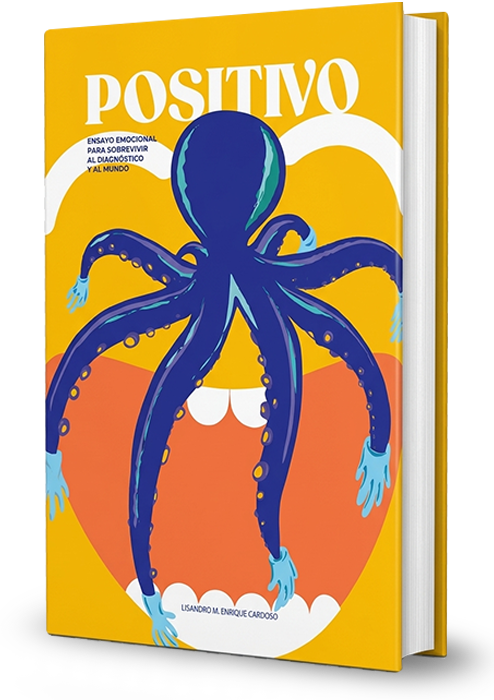
Positivo an emotional essay

It's not about being okay all the time.
It's about stopping measuring yourself by that.

Notify me when it's out

Please, check your inbox, and confirm. No spam. Just one email when the book is available.

Portada del libro Positivo de Lisandro M. Enrique Cardoso

"Shame doesn't belong to me. It's borrowed."

"To name something is to begin freeing yourself from it."

"HIV was there with me. I decided we'd have to get along."

"I wasn't afraid of HIV. I was terrified the doctor would be right."

"Continuing to live is also a decision."

"Guilt changes when it stops looking for someone to blame."

"You can want a cure and still make peace with the condition."
"Shame doesn't belong to me. It's borrowed."

"To name something is to begin freeing yourself from it."

"HIV was there with me. I decided we'd have to get along."

"I wasn't afraid of HIV. I was terrified the doctor would be right."

"Continuing to live is also a decision."

"Guilt changes when it stops looking for someone to blame."

"You can want a cure and still make peace with the condition."

The book

Some books tell you how to feel.
This one asks instead.

Positivo is not a self-help manual. Not a medical guide. It won't tell you "undetectable = problem solved" or that "HIV doesn't define you" as if either of those were that simple to believe.

It's an autobiographical and philosophical essay written by someone who has lived with HIV since 1994. Who took more than 20 years to say it out loud. Who knows the difference between silence as strategy and silence as self-punishment.

A book that asks uncomfortable questions: when does silence stop being protection? Who has the right to your truth? Can you want a cure and still make peace with the condition at the same time?

There are no definitive answers. There's something better: honesty.

If the first thought that crosses your mind after an HIV diagnosis is that you're going to die, the answer I have for you is: yes, you are. So am I. So is everyone. All you need in order to die is to be alive.

— Introduction

I learned that denial isn't always about denying reality. Sometimes it's a form of resistance. Sometimes it's a way of telling pain: "Hey, I don't have time for this right now."

— On the early years

We were told normalisation would come with medical progress. And it did. But what about everything outside the biomedical? Stigma still wears you down. It's the other chronic inflammation nobody talks about.

— Epilogue

Who is it for?

For those who want honesty,
not cotton candy.

People living with HIV

Recently diagnosed or with years of history. For those who've heard all the slogans and something still rings hollow.

Partners, families, health workers

Those who want to understand what the brochures leave out.

Readers of personal essay

For those who read narrative that isn't afraid to mix with philosophy, criticism, and raw emotion.

Not for those who need slogans to avoid thinking.

Not for those seeking mandatory optimism. Or those who think "Positivo" means everything is fine.

Not for those who prefer comfortable silence.

Families, professionals or institutions who choose to speak in abstractions rather than get their hands dirty.

Not for those who reduce HIV to the biomedical.

"Undetectable = solved." Science moves faster than stigma, and that gap is exactly what this book is about.

Inside the book

A journey without easy answers.

01

The diagnosis

Córdoba, 1994. A doctor without empathy, a partner who "already knew", and the decision not to take medication. How the brain does strange things when faced with horror.

02

The shape of the virus

Learning to call it by its name. Why saying it out loud changes something in the body. The meditations, the Bach flowers, and the silence of the early years.

03

Protection or omission?

The dilemma of silence in relationships. Fear of rejection, fear of violence, and the moral asymmetry of knowing something the other person doesn't.

04

The politics of truth

Being forcibly outed at a dinner party. Who has the right to your story. How lying can be, in certain contexts, the most radical act of self-love.

05

Managing emotions

Fear, anxiety, shame, guilt. Not as textbook concepts, but as concrete physical experiences. Tools that aren't magic but work.

06

Heteropositive

HIV doesn't have one face or one body. Expanding the conversation beyond the stereotypes that still define how we talk about the virus.

Ep.

Epilogue: forgiveness

The hate-filled voice message I kept for years. Why I finally deleted it. Goodbye guilt. Hello shared responsibility. Continuing to live is also a decision.

Lisandro M. Enrique Cardoso

@lisandropositivo

The author

Lisandro M.
Enrique Cardoso

Writer, ontological coach and HIV activist. Born in Buenos Aires in 1975, based in Barcelona. Living with HIV since 1994.

For years he supported newly diagnosed people through social media — first without knowing that had a name, later as part of his work at BCNCheckpoint in Barcelona and Acción Triángulo in Madrid, and as a certified coach from UNC — Universidad Nacional de Córdoba, Argentina.

Positivo is his first book. It grew from 30 years of personal experience and accompanying others — and from the conviction that science moves faster than stigma, and that gap has a cost worth naming.

En tus manos en el
verano europeo del 2026.

One email when the book is available. No newsletter, no spam, nothing else.

Available in print (Spain) and ebook (worldwide)